The Difference between Raster and Vector for the AM.CO.ZA InkRIP Software (Part 1)

inkrip raster vector difference
When it comes to working with print software, it is important to understand the common file types and formats.
These file type Vector and Raster will work better for different workflows and end results, so knowing which one to use and when too, will give you the best end result.
This video is part of a Mini-Series.
The next video covers RGB vs CMYK.
Video Transcript
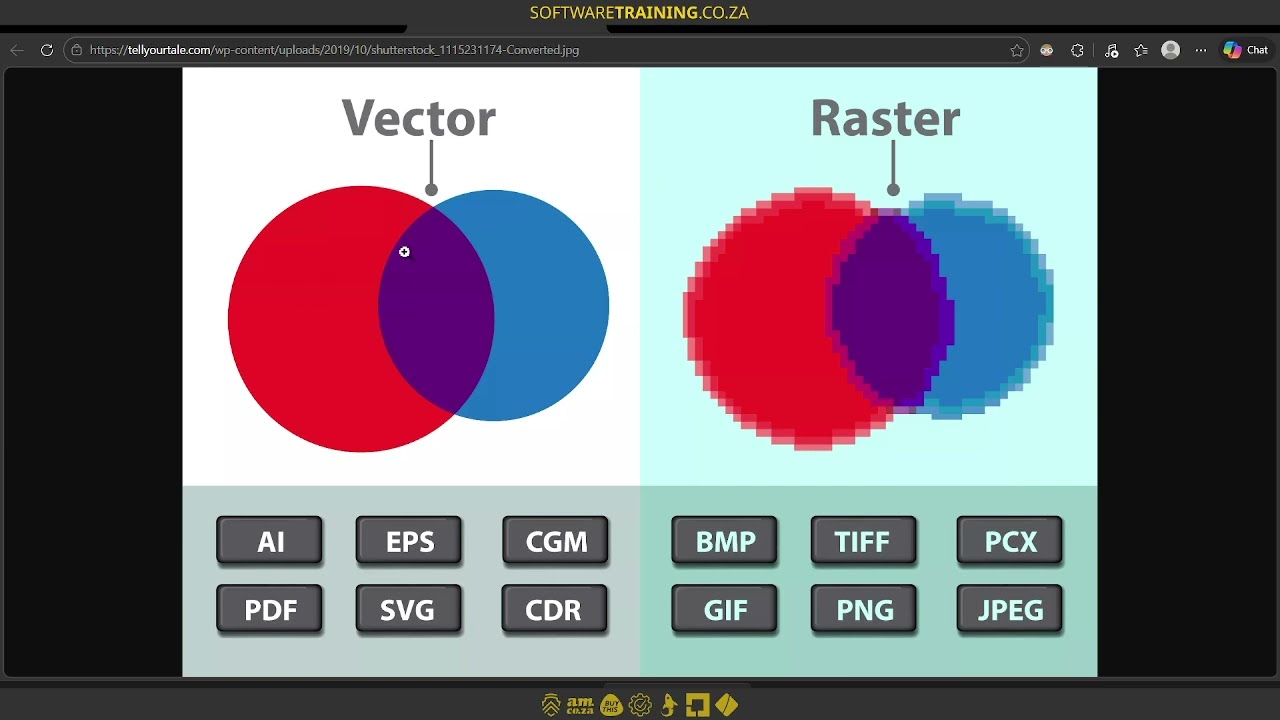
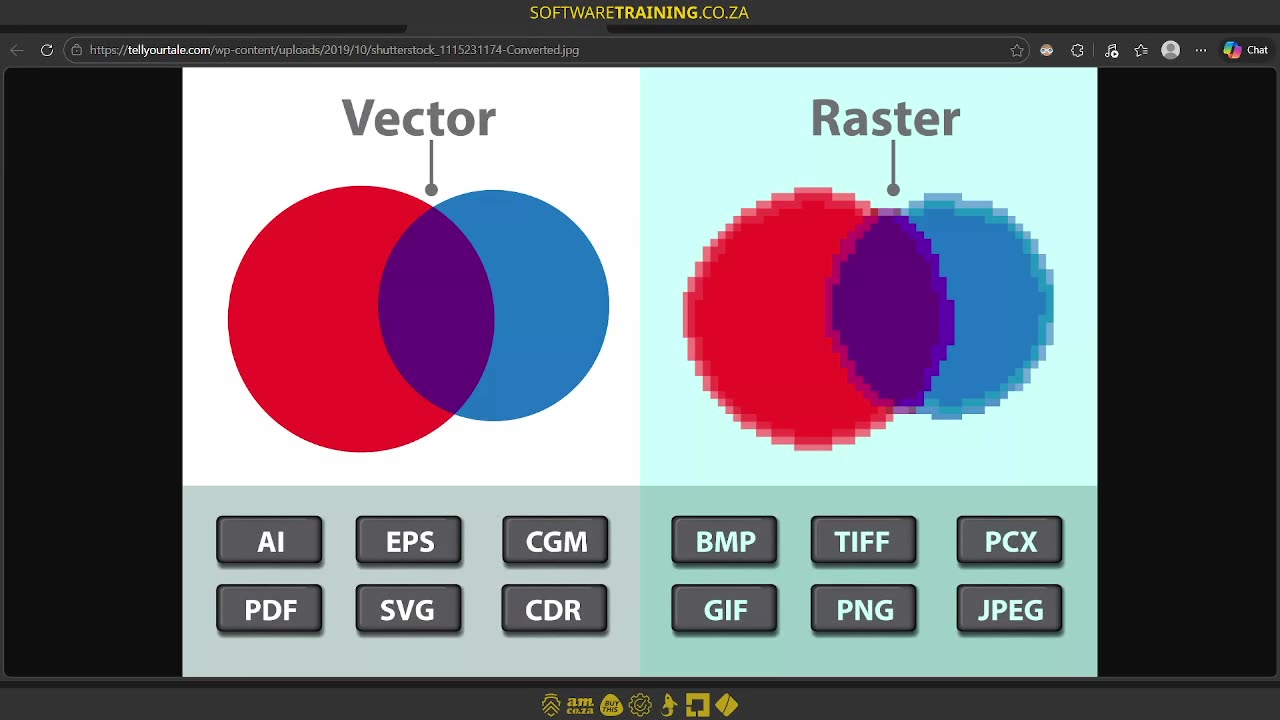
Howdy, guys. In today's video, we're gonna head into design practises and we're gonna look at what's the difference between raster and vector. But before that, let's have a quick intro first. So, today's video can be found on softwaretraining.co.za. We make short and easy to watch problem solving videos, and we also have daily updates. So now, like I mentioned, we're gonna be looking at some design practises in this miniseries, and there's a few things that's important to note, but we'll start off with vector and raster. So now, in general, this is the two most common designs you're gonna be working with. So, on the left here, you guys can see we've got the actual vector, and then on the right, we have the raster. Well that comes down to If you want to break it down more simple, a vector form is something that's, or design is calculated by a mathematical equation, so it's got two points and then it's got an equation to work out the arcs, the distance, and so forth. Now, when it comes to a raster, this is gonna be pixel-based. So, every pixel has its own value and then depending on the density of the pixels, or how many is next to each other and um how big or large the images, they'll also determine how high-quality the images. Now, when it comes to vector, when you'll mostly use these or in kind of like logo designs or more simple designs. So if it's like few colours, simple shapes, simple text, so forth. It's not extreme shading or anything like that. So, in return, this works pretty well for most corporate designs. A lot of websites as well. You can see it's very popular for that. Where, when it comes to RSA, this is very common again when it comes to stuff like photographs or high-quality art or anything in that line. Uh, it's gonna be rasta. Now, you do get a formal process like we are covering an encrypt, where what will happen is it will take a vector design, and it will rip it into a raster. So then you could, uh, how can I say, have a. A very large design that you can scale to any size. And then rip it, and then the printer can actually print it at that new size and so forth. And now, common formats. So when it comes to vector, Adobe Illustrator files, so the AI and the EPS is very popular, and then also the PDF and SVG. Now, this is uh you can also commonly use this with open-source programmes. So, I would say these two are quite popular. PDFs can be a mix of images and vector, but a lot of people like to send their, I say, sorry, RAS and vector, but a lot of people like to send their files as PDFs. Then, when it comes to RAS formats, common ones are Bitmaps, TIFF, and then PNG and JPEG, but I would say when it comes to printing, you're most likely gonna be using TIFF files as it can store alpha values. Which is like transparent backgrounds and also higher information when it comes to colours and so forth. So, overall, it is a good overall. But yeah, otherwise, that is it on the actual difference between vectors and rasters. So if we head here to softwaretraining.co.za. You guys will notice, we've got a variety of different softwares we do cover, and you can also isolate your search on the top right. If you do not, however, find the training videos you're looking for, just simply go on the left, request the training video, and then we'll do our best to try and make that for you. But otherwise, thanks guys for watching and cheers.